

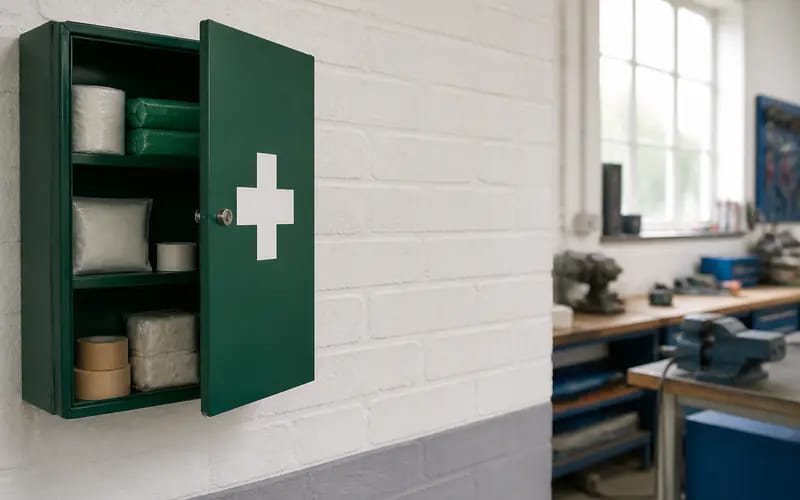
Most companies have some sort of first aid in place but does it amount to enough for the workplace? Take a few minutes to carry out a simple check to see if you have an adequate first aid provision for your workplace.
Start With A Proper Needs Assessment
Guesswork is often the reason that first aid cover does not match the workplace. In order to assess your first aid needs you must consider the size of your workforce and the type of work that they do, as well as the layout of your premises. Once you have considered these factors, you can complete a first aid needs assessment as outlined by the HSE. A warehouse with moving machinery will require different amounts of first aid cover than an office with low risk of injury, even if both have 10 members of staff.
Count Trained First Aiders Against Staff Numbers
The number of staff on your busiest shift vs the number of trained first aiders covering that same shift is a simple exercise to reveal first aid gaps. Low risk offices can get away with lower first aider-to-staff ratio’s than higher risk environments such as workshops, kitchen environments or construction sites with machinery. Typically higher risk environments require a higher first aider-to-staff ratio and for some roles it may be beneficial to have someone with more advanced first aid training on site at all times.
Check Cover Across Every Shift
Many businesses have good first aid cover during the day but have little or no cover at night, on weekends or early starts. This also includes lone workers and those based in remote or satellite sites. A trained first aider based at a head office is of little use to someone who works alone 20 miles or so from there.
Look Back Through Your Accident Book
A review of your previous year’s accident book can often highlight areas of your business where help to treat an injury has taken too long to arrive, instances where incorrect first aid treatment has been provided and also situations where minor injuries have developed into more serious problems through lack of proper treatment by a trained first aider.
There is more on Emergency First Aid Training Courses at Emergency first aid training courses by Tidal Training.
Check Certificate Expiry Dates Now
Many first aid certificates are valid for 3 years. It is surprisingly common for employers to discover that a first aider’s certificate has lapsed when they need to use them for an incident. Make a simple list of all your first aiders and their renewal dates. Identify those that are due to expire within the next few months and book their refresher courses in good time to avoid them being without cover whilst you wait for their certificate to be renewed.
Identify Higher Risk Areas Needing Extra Skills
Most workplace accidents require more than basic first aid. In kitchens, warehouses and workshops for example, there is a higher incidence of burns and cuts from machinery. In such cases staff need to have knowledge of severe bleeding and specific injuries that have occurred as a result of the equipment used in that workplace. Having staff with emergency first aid skills in these areas can help to deal with incidents quickly and provide the necessary treatment until more advanced medical help arrives.
Check Kits And Defibrillators Are Where People Work
Make sure the fully stocked first aid kits are not left in a cupboard or office two floors away from where your trained first aiders work. Check all your first aid kits are in date and fully stocked and are located in the best place for your trained first aiders. This is not necessarily near the fire exit or reception area where you may have first aid kits located years ago. Also check the battery and pads on any defibrillators are in date. These are frequently found to be out of date.
Ask Staff If They Know Where To Go
Ask your staff who the first aiders are and where the first aid equipment is stored. It’s surprising how staff will not know who the first aiders are or where the first aid kit/defibrillator is stored even when your workplace has first aid provision. This can easily be sorted with a short email to all staff and the information placing on a notice near the equipment.
Go through the above points over the next week or so and you will find out whether your company’s first aid cover is as good as you thought it was.