

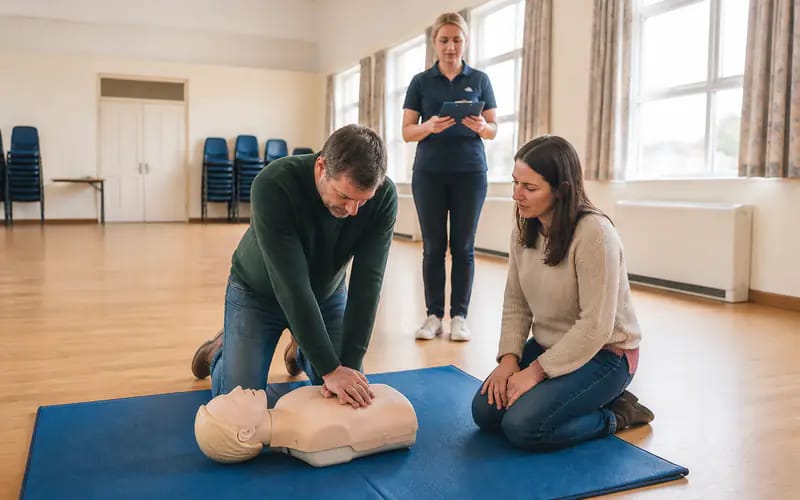
You may be worried that assessment for a first aid course is going to be a daunting experience for you. However, we have explained exactly what you can expect to happen during the first aid course in full detail.
Assessment Happens All Day
There is often a perception that an assessment will be a single event at the end of a course. As the candidate is practising skills throughout the day the trainer is monitoring their progress. This means that every time you practice a skill such as bandaging a wound or checking for a response the trainer is noting your progress. This type of assessment continues throughout the day and removes much of the pressure that would exist in a single event assessment.
Hands-On Skills You’ll Demonstrate
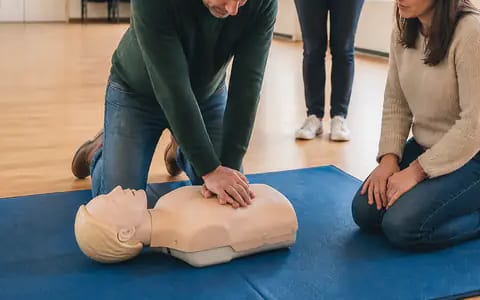
You will be expected to use all of the skills that you have learned during the course. Practical assessment includes using a manikin for practice of CPR, using a defibrillator and managing a casualty with injuries including putting them in the recovery position and controlling bleeding using direct pressure and dressing wounds. The practical skills are practised on many occasions and usually in pairs, or in small groups of 3, to allow the trainer to assess candidate’s ability to use skills for themselves rather than just getting it right by chance on the first attempt.
Scenario Based Assessment
At the end of the course you will be required to go through a number of simulated scenarios (based on real life accidents and emergencies) within the course, e.g. someone collapsing or suffering a serious injury. You will be expected to go through the various stages of the first aid treatment in the correct order. These are: safety, assessment, treatment and monitoring. The scenarios are designed to test your ability to apply your knowledge in a realistic situation.
More on Emergency First Aid Training Courses can be found at Tidal Training emergency first aid training courses.
A Short Knowledge Check
There may also be a short written or verbal assessment at the end of the session to ensure that you have grasped the key priorities in any given situation. This would cover issues such as ensuring that the scene is safe for you to approach, calling for an ambulance at the earliest opportunity and assessing the casualty’s condition whilst waiting for them to arrive.
What The Trainer Is Really Looking For
Trainers are not looking for candidates to repeat back from memory what they have learned from the course in exact words. What they are looking for is for candidates to demonstrate the correct use of skills and to make decisions in a logical and safe manner. Candidates do not have to get everything 100% right and can still pass if they ‘stumble’ over some of the rules. Importantly, candidates must show that they are able to use their newly learned skills in practical, realistic situations.
If You Struggle On The Day
Just because you may have failed to complete part of an assessment does not mean you will fail the whole course. In first aid courses candidates are given the opportunity to practice and be assessed on techniques such as defibrillator use. Even if the candidate fails to place the defibrillator pads correctly or fails to complete chest compressions at the correct rate the trainer can give extra one-to-one practice to help the candidate to understand and complete the required skills.
Who Is Qualified To Assess
An effective instructor for an emergency first aid training course has more than first aid knowledge. In addition to this they must hold an Instructor qualification and Assessor Qualification from an awarding body that is regulated to deliver workplace first aid training. As with any assessor their own competence is monitored and updated as necessary.
After You Pass
Passing the assessment for an emergency first aid training course means that, upon successful completion of the course, you will receive a certificate which is valid for 3 years from the date of completion of the course. Many workplaces will expect employees to undertake refresher first aid training courses prior to the 3 years having lapsed in order to revalidate their first aid certification for work purposes.
First aid courses are set up to help you. So, even though an assessed first aid course may seem daunting before you start, the training is designed to help you to achieve a certificate that proves you can use first aid in a real emergency and do it well.